


T2I TeamInformation Processing to Adapt Interaction to the Context and the User
Overview
The research activities of the T2I team focus on the following scientific challenges:
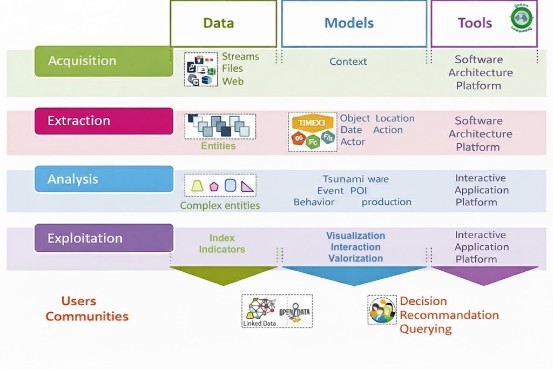
- Software models, architectures, and platforms supporting the acquisition of spatio-temporal data streams and the dynamic adaptation of applications to the captured context;
- Models and platforms for the extraction, indexing, enrichment, analysis, and retrieval of targeted information (according to spatial, temporal, and thematic dimensions);
- Models and tools enabling the presentation and valorization of captured information for context-aware and user-adaptive interactive applications.
Overall, the work of the T2I team addresses data throughout the entire lifecycle, from acquisition (data capture) to exploitation, with the aim of supporting decision-making and information valorization.
Research Themes
The T2I team is structured around four thematic axes.
Targeted information extraction, indexing, and retrieval
This research activity focuses on information contained in heterogeneous documents and data streams for the purposes of representation, indexing, retrieval, and exploitation. It encompasses the modelling of targeted information and the construction of resources required for semantic processing; the processing of raw data (acquisition, recognition, segmentation); analysis (segmentation, semantic processing, annotation, indexing); and exploitation (filtering, data mining, information retrieval, decision support, and result presentation).
Context Adaptation and Autonomic Computing
This research activity focuses on context modelling (formal or informal), its consideration (evaluation), and adaptation mechanisms, following approaches based on the MAPE-K loop (Monitor, Analyse, Plan, and Execute + Knowledge). It raises challenges related to knowledge modelling, data acquisition (including classical issues of heterogeneity and normalization), as well as decidability issues when context is leveraged for autonomic purposes.
User-Centred Environments: Distributed Interactions and Computer Environments for Human Learning
The distributed interactions component addresses issues related to interaction and interaction modalities, as well as challenges associated with distribution, mobility, and context awareness.
The computer environments for human learning component aims to propose frameworks that, on the one hand, enable the modelling of learning environments and, on the other hand, exploit traces of learners’ pedagogical activities. Learning environments are accessible anywhere, at any time, and from any device equipped with an Internet connection. To date, the conducted research has made it possible to partially model the context in which students carry out their learning activities (e.g., access to a Learning Management System, completion of remote hands-on activities in class).
Green Computing
This is an emerging research axis of the team. It focuses on incorporating eco-responsibility into applications. Currently, this dimension is taken into account primarily at the hardware and data centre levels, while it is largely absent at the application level and entirely absent at the conceptual level.
Researchers of the T2I team
Permanent members
|
Last name First name |
Situation |
Site |
|
Associate professor |
Pau | |
|
Associate professor |
Anglet | |
|
Associate professor |
Anglet | |
|
Associate professor |
Anglet | |
|
Associate professor |
Bayonne | |
|
Associate professor |
Pau | |
|
Professor |
Anglet | |
|
Associate professor |
Anglet | |
|
Associate professor |
Anglet | |
|
Professor |
Anglet | |
|
Professor |
Anglet | |
|
Professor |
Pau | |
|
Vallès-Parlangeau Nathalie |
Associate professor |
Anglet |
email: firstName.lastName@univ-pau.fr
Associate members
|
Last name First name |
|
Cardinale Yudith |
PhD students
|
Last name First name |
Site |
|
Darricades Charlotte |
Pau |
|
Demonda Ghislain |
Pau |
|
Ma Zhongwei |
Anglet |
|
Pompejano Adriana |
Anglet |
|
Anglet | |
|
Zhang Yunji |
Anglet |
Publications